Breaker Keeps Tripping? Safe Homeowner Checks
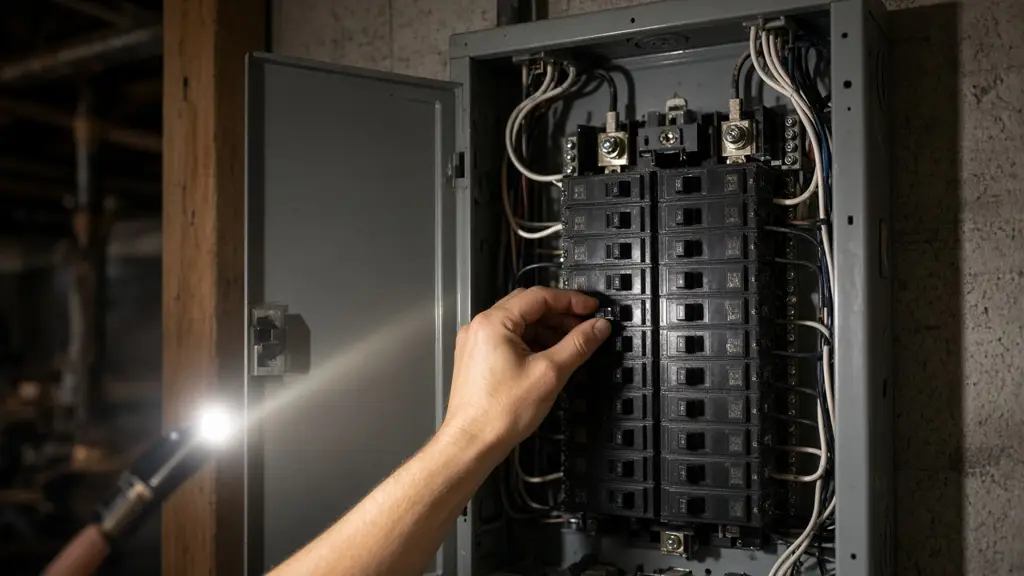
When a circuit breaker trips, the lights or outlets on that circuit go dead. Often the cause is simple, like too many appliances running at once. But a breaker that trips again and again is telling you something, and the fix is not to keep flipping it back on. This guide walks through what a homeowner can safely check from outside the panel, and where the job belongs to a licensed electrician.
Safety first: Do not remove the panel's inner cover (the "dead front") or touch anything behind it. Resetting a breaker handle is a normal homeowner task; working on wiring inside the panel is not. If you see scorch marks, smell burning, hear buzzing or crackling from the panel, or the panel feels hot, keep away, and call a licensed electrician. If there is smoke or fire, leave and call 911.
What a breaker does
Breakers protect the wiring in each circuit from overheating. According to the Electrical Safety Foundation International (ESFI), fuses and breakers stop the current when it exceeds a safe level for that part of your system. Some breakers add extra protection:
- Standard breakers trip on overloads and short circuits.
- AFCI breakers (arc-fault circuit interrupters) also trip when they detect dangerous arcing, the kind caused by damaged, pinched or overheated wiring and cords.
- GFCI breakers (ground-fault circuit interrupters) trip on ground faults, when current leaks along an unintended path, which protects people from shock.
- Dual-function breakers combine AFCI and GFCI protection.
If a breaker has a TEST button, read its label to see which kind it is.
The three common reasons breakers trip
- Overload. Too much equipment running on one circuit. This is the most common cause, and it often happens when a space heater, hair dryer, microwave or vacuum is added to a circuit that's already busy.
- Short circuit. A hot conductor touches a neutral or another hot, often from damaged wiring, a faulty appliance, or a loose connection. Breakers usually trip immediately and sometimes with a loud snap.
- Ground fault or arc fault. Detected by GFCI or AFCI protection. Moisture, a damaged cord, a nail through a wire, or a failing appliance can all cause it.
Step 1: Unplug and switch off what's on the circuit
Before touching the panel, go to the rooms that lost power. Turn off lights and unplug appliances, chargers and power strips on that circuit. Resetting a breaker into a full load can make it trip again instantly.
Step 2: Find the tripped breaker
Open the panel door (just the door, not the inner cover). Use a flashlight. A tripped breaker is usually in the OFF position or stuck in a middle position between ON and OFF. Some have a colored trip indicator.
Step 3: Reset it once
Stand to the side of the panel, with dry hands and dry feet. Push the breaker handle firmly all the way to OFF, then back to ON. ESFI's reset instructions follow this same off-then-on sequence. A breaker in the middle position won't reset unless you push it fully to OFF first.
Step 4: Add things back one at a time
Plug devices back in and switch them on one by one, waiting a moment between each. Note what you're doing when it trips.
| When it trips | Likely cause | What to do |
|---|---|---|
| Right after you reset it, with everything unplugged | Short or fault in the wiring or a device in the circuit | Leave it off and call an electrician |
| When one particular appliance turns on | That appliance or its cord is faulty | Unplug it and try it on a different circuit only if you see no damage; otherwise have it repaired or replaced |
| After several things have been running a while | Overload | Move heavy loads to other circuits |
| AFCI breaker trips with no obvious load | Possible arcing in a cord or wiring | Inspect cords; if it repeats, call an electrician |
| GFCI breaker trips in wet weather or with an outdoor device | Moisture or ground fault | Check outdoor outlets and covers; call an electrician if it persists |
Step 5: Reduce the load on busy circuits
If it's an overload, spread things out:
- Follow NFPA's advice to plug only one heat-producing appliance (coffee maker, toaster, space heater, etc.) into a receptacle at a time.
- Plug major appliances (refrigerators, washers, dryers, microwaves, air conditioners) directly into a wall outlet, not an extension cord or power strip.
- Don't use extension cords as a long-term fix. NFPA describes them as intended for temporary use; if you need more outlets, have an electrician add them.
Step 6: Inspect cords and plugs
With the device unplugged, look for frayed or cracked cords, bent or loose prongs, scorch marks, and cords that have been pinched under furniture or doors or run under rugs. ESFI notes that damaged, pinched and overheated cords can cause arc faults. Replace damaged cords or the appliance; don't tape them up.
Step 7: Test AFCI and GFCI breakers monthly
If you have AFCI or GFCI breakers, ESFI recommends testing them each month: with the breaker ON, press TEST. It should trip. Reset it by moving it fully OFF and then ON. If it doesn't trip, call a licensed electrician to replace it. A device that doesn't work gives a false sense of protection.
Signs you need a licensed electrician
NFPA advises calling a qualified electrician (or your landlord) if you have any of these:
- Frequent problems with blown fuses or tripping breakers
- A tingling feeling when you touch an appliance
- Discolored or warm wall outlets
- A burning or rubbery smell from an appliance
- Flickering or dimming lights
- Sparks from an outlet
Add to that: a breaker that won't stay on with nothing plugged in, a breaker that's hot to the touch, a panel that buzzes, or a home with an older fuse panel or one that's never been inspected. ESFI recommends an electrical inspection for homes older than 40 years or after a major renovation or large new appliance.
What not to do
- Never hold a breaker in the ON position or tape it on.
- Never replace a breaker or fuse with a higher-amp one to stop the tripping. ESFI warns that an oversized fuse is a dangerous fire hazard; the same principle applies to breakers, which are sized to protect the wire.
- Don't remove the panel's inner cover.
- Don't keep resetting a breaker that trips immediately.
Quick recap
Unplug, reset once (fully OFF, then ON), and add loads back one at a time to see what triggers it. Spread heavy appliances across circuits, retire damaged cords, and test AFCI/GFCI breakers monthly. If it keeps tripping, trips with nothing on, or you notice heat, smells or sparks, it's time for a licensed electrician.
Related guides
- GFCI Outlet Won't Reset? Safe Troubleshooting Steps
- Outlet Not Working? Safe Checks Before You Call an Electrician
- How to Replace a Single-Pole Light Switch Safely
Sources and further reading
- ESFI: Understanding your home electrical system
- ESFI: Fuse and breaker breakdown
- ESFI: How to test an AFCI
- NFPA: Electrical safety in the home
- NFPA: Electrical safety tip sheet (PDF)
Sources checked October 23, 2026. If something here does not match your product's manual, follow the manual and let us know.
Frequently asked questions
Is it dangerous if a breaker keeps tripping?
A breaker that trips is doing its job: stopping current that is too high or abnormal. But frequent tripping is a warning sign. NFPA lists frequent problems with tripping breakers among the reasons to call a qualified electrician.
How many times can I reset a tripped breaker?
Reset it once after unplugging or turning off what's on the circuit. If it trips again right away, or keeps tripping with a light load, stop resetting it and call an electrician.
Why does my breaker trip when I use the microwave and toaster together?
Heat-producing appliances draw a lot of current. Running two on the same circuit can overload it. NFPA recommends plugging only one heat-producing appliance into a receptacle at a time.
What is the TEST button on some breakers?
Breakers with a TEST button are usually AFCI or GFCI (or dual-function) breakers. The label on the breaker tells you which. ESFI recommends testing them monthly.
Can I replace a breaker myself?
Working inside the panel exposes you to parts that stay energized even with the main breaker off in many setups. Breaker replacement is a job for a licensed electrician.