How to Fix Low Water Pressure in a Faucet by Cleaning the Aerator
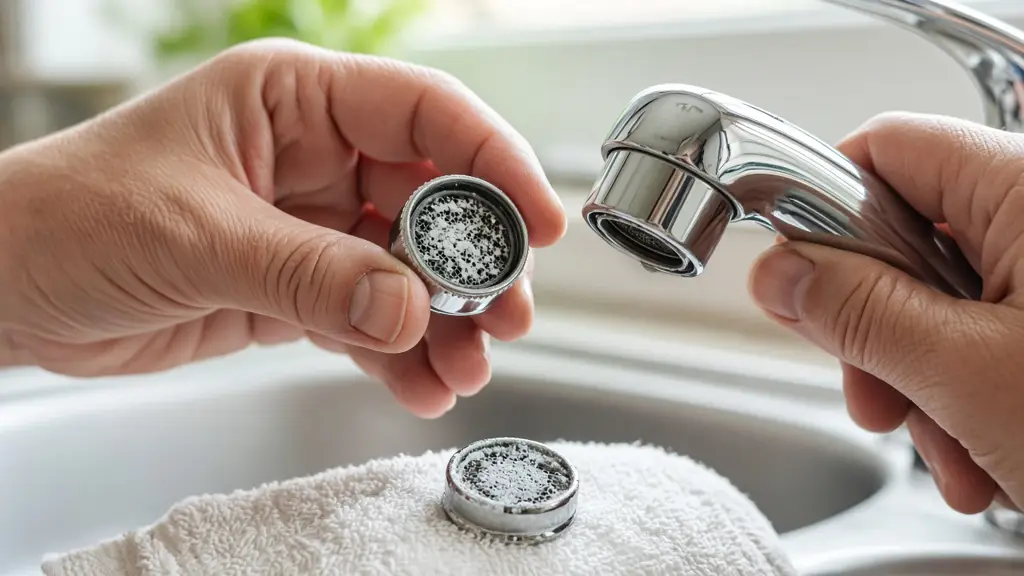
When one faucet suddenly trickles while the rest of the house is fine, the cause is usually small and cheap: the aerator. That's the screw-on tip at the end of the spout. It mixes air into the stream and holds a fine screen that catches grit and mineral flakes. Over time the screen clogs, and flow drops.
This is one of the easiest plumbing fixes in a home. In most cases you need no tools beyond a cloth and pliers, and it takes about 15 minutes plus soaking time.
First, confirm it's just this faucet
Turn on a few other faucets, hot and cold.
- Only one faucet is weak: The aerator or that faucet's cartridge is the likely cause. Keep reading.
- Only the hot side is weak everywhere: The issue is more likely at the water heater (sediment, a partly closed valve). See our guide to water heater popping noises and flushing.
- The whole house is weak: Check that the main shutoff valve is fully open, ask neighbors if they're affected, and contact your water utility. A failing pressure-reducing valve is a job for a plumber.
Tools and materials
- Soft cloth or masking tape (to protect the finish)
- Slip-joint or adjustable pliers
- Small bowl and white vinegar
- Old toothbrush and a toothpick or pin
- Aerator key, if your faucet has a hidden (cache) aerator, usually supplied with the faucet or available from the manufacturer
- Replacement aerator, if the old one is damaged
Step 1: Plug the drain
Close the drain stopper or lay a towel in the sink. Aerators have small parts, such as screens and rubber washers, that disappear down a drain easily.
Step 2: Unscrew the aerator
Most aerators unscrew counterclockwise when you look up at them from below.
- Try by hand first, with a dry grip.
- If it won't budge, wrap it with a cloth or tape and turn gently with pliers. Don't squeeze hard: aerator housings are thin and can deform.
- If your spout has no visible threads and a recessed tip, you probably have a cache aerator. Insert the plastic key that came with the faucet and turn it.
Pull-down kitchen sprayers usually have a spray face that unscrews or a rubber-nub face that can be cleaned in place. Follow the manufacturer's care instructions for your model.
Step 3: Test the flow without it
Before cleaning, turn the faucet on briefly with the aerator off.
- Strong flow: The aerator was the problem. Go to Step 4.
- Still weak: The blockage is inside the faucet. Skip to "If the flow is still weak" below.
Step 4: Take it apart and clean it
Note the order of the parts as you remove them. Taking a phone photo helps. A typical aerator has a housing, one or more screens or a flow insert, and a rubber washer.
- Push the insert out of the housing with your thumb or the back of a toothbrush.
- Rinse the parts under water and brush off loose grit.
- Soak the metal and plastic parts in white vinegar for 30 minutes to a few hours to soften mineral scale. Leave out the rubber washer.
- Scrub again and clear any blocked holes with a toothpick. Avoid metal picks that could enlarge holes.
- Rinse well.
If you can't detach the aerator, you can tie a small bag of vinegar around the spout so the tip is submerged. Check your faucet maker's care guide first, because some finishes can be damaged by acids. Rinse thoroughly afterward.
Step 5: Reassemble and reinstall
- Put the parts back in the original order, washer last.
- Thread the aerator on by hand, clockwise, until snug.
- Turn on the water and check for leaks around the threads. If it drips, tighten a little more or check that the washer is seated flat.
When to replace instead of clean
Replace the aerator if:
- The screen is torn or the plastic insert is cracked.
- Scale won't come off after soaking.
- The threads are damaged.
Bring the old aerator to a hardware store to match the size and thread type. Many replacement aerators list a flow rate in gallons per minute (gpm). Under federal standards, new lavatory faucets are limited to 2.2 gpm at 60 psi, and EPA WaterSense-labeled bathroom faucets and aerators use no more than 1.5 gpm. Kitchen faucets usually use a higher-flow aerator than bathroom sinks, so match the original if you're not sure.
If the flow is still weak
- Check the shutoff valves under the sink. Make sure both are fully open. Older multi-turn valves can be partly closed or clogged with scale.
- Check the supply lines. A kinked braided supply line will restrict flow. Replace it if kinked or bulging.
- Check the cartridge. Debris often lodges at the cartridge inlet. Cleaning or replacing it uses the same steps as our guide on fixing a leaky single-handle faucet.
- Only hot or only cold is weak at this faucet: The cartridge, the valve on that side or the supply line on that side is the likely restriction.
How to prevent it
- Clean aerators once or twice a year, more often if you have hard water.
- After any plumbing repair or a water main break in your area, run the faucets with the aerators removed for a minute to flush out debris, then reinstall them.
When to call a plumber
- The whole house has low pressure.
- Shutoff valves are seized or leak when you turn them.
- Pressure is low at one fixture even after cleaning the aerator and cartridge, which may point to a pipe problem inside the wall.
Related guides
- How to Fix a Leaky Single-Handle Faucet
- How to Unclog a Kitchen Sink
- Why Is My Water Heater Making Popping Noises?
Sources and further reading
- EPA WaterSense: Bathroom faucets (WaterSense flow rate and federal faucet standard)
- EPA WaterSense: Fix a Leak Week
- Your faucet manufacturer's care and cleaning instructions, especially for specialty finishes and pull-down sprayers
Sources checked October 23, 2026. If something here does not match your product's manual, follow the manual and let us know.
Frequently asked questions
How do I know if the aerator is the problem?
Unscrew the aerator and run the faucet briefly. If the flow is strong without it, the aerator (or its screen) is clogged. If the flow is still weak, the restriction is further back: the cartridge, the supply lines or the shutoff valves.
Can I run the faucet without an aerator?
It will work, but water will splash more and you lose the flow limit the aerator provides. Use it as a short test, then reinstall a clean or new aerator.
What size aerator do I need?
Take the old one to the store or compare it with a coin-sized aerator key gauge. Common sizes are standard, junior and Tom Thumb, with male or female threads. Many faucet brands also sell exact replacements, including hidden (cache) aerators that need a special key.
Why did my water pressure drop right after plumbing work?
When water is shut off and turned back on, loosened scale and debris often travel to the nearest aerator. Cleaning the aerators throughout the house usually fixes it.