Garbage Disposal Humming But Not Working? How to Unjam It
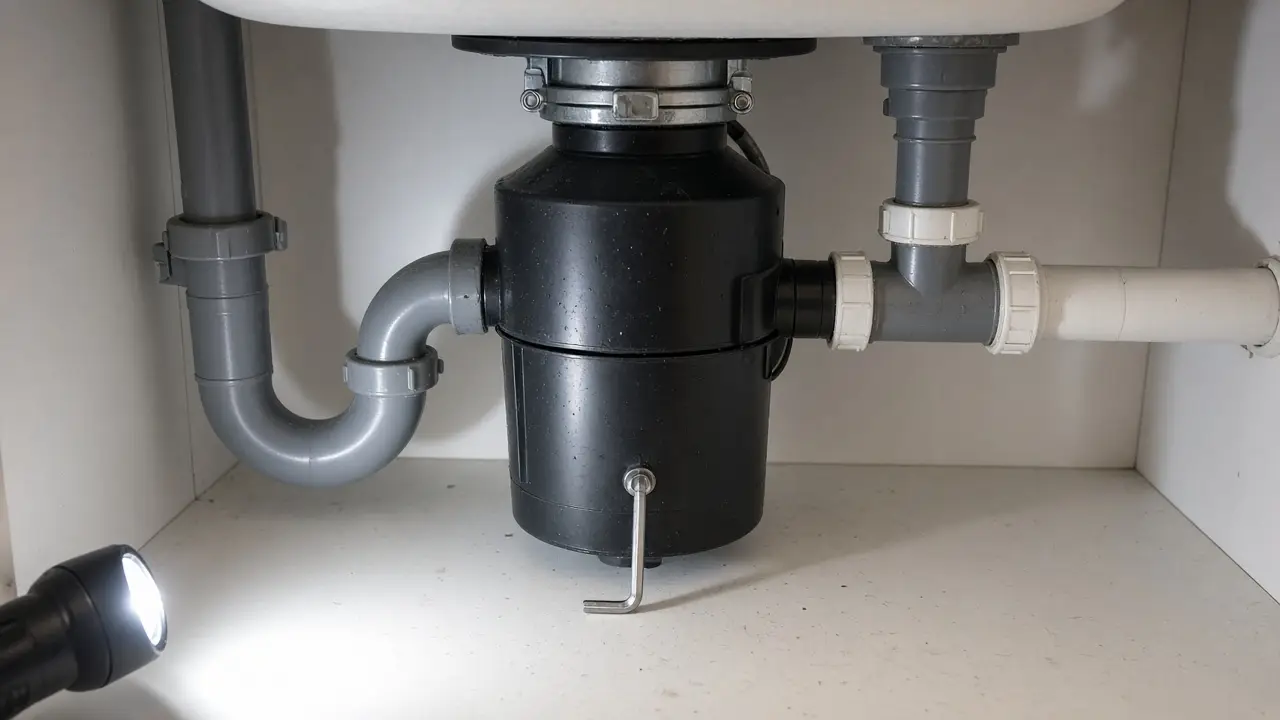
You flip the switch and hear a low hum, but nothing grinds. That sound means the disposal's motor is getting power, but the grinding plate (flywheel) can't turn, usually because something is jammed between the plate and the grind ring. Running a jammed disposal for long can overheat the motor, so turn it off and follow these steps.
Safety first: Never put your hand into a garbage disposal. Before working on it, turn off the wall switch and the breaker, or unplug the unit if it plugs into an outlet under the sink.
Tools and materials
- Flashlight
- 1/4-inch hex (Allen) key, or the wrench that came with the disposal (check your model's manual)
- Long tongs or needle-nose pliers
- Broom handle or a wooden spoon (for disposals without a hex socket)
- Towel
Why disposals jam
Common culprits include:
- Fruit pits, bones and corn cobs
- Utensils, bottle caps, twist ties or small toys that fell in
- Fibrous foods like celery, corn husks and onion skins that wrap around the parts
- Large amounts of starchy food such as rice, pasta or potato peels that pack into a paste
- Running the disposal without enough water
Step 1: Cut the power
Turn off the disposal's wall switch. Then turn off the breaker that feeds it, or unplug it under the sink. Test the switch to confirm nothing happens.
Step 2: Look for the obstruction
Shine a flashlight into the drain opening. If you see an object like a spoon or a pit, remove it with tongs or pliers. Don't use your fingers.
Step 3: Free the flywheel with a hex key
Most disposals have a hex-shaped socket in the center of the bottom of the unit, designed for exactly this.
- Insert the hex key into the socket.
- Work it back and forth, turning in both directions. You'll feel resistance at first.
- Keep working it until the key can turn full circles freely. This frees the plate from whatever was binding it.
- Remove the key.
If your model has no socket, some manufacturers suggest inserting a broom handle into the drain opening (with power off) and levering against the grinding plate to rotate it. Check your manual first.
After freeing it, shine the flashlight in again and remove any debris that came loose.
Step 4: Press the reset button
When a disposal jams and hums, the motor often overheats and trips a built-in thermal overload protector. Look on the bottom of the unit for a small red or black button.
- Let the motor cool for about 10 to 15 minutes.
- Press the reset button firmly. If it was tripped, you'll feel a click.
Step 5: Test it
- Restore power at the breaker or plug it back in.
- Run cold water into the sink.
- Turn on the disposal. It should spin up and run normally.
- Let it run with water for 20 to 30 seconds to flush any loosened debris.
If it still hums or does nothing
| Symptom | Possible cause | Next step |
|---|---|---|
| Still hums, won't turn | Jam not fully cleared, or a seized motor | Repeat Step 3; if the key won't turn at all, the bearings may be seized |
| No sound at all | Tripped reset, tripped breaker, or a bad switch | Press reset, check the breaker, check that the plug is seated |
| Trips reset again quickly | Partial jam or failing motor | Clear again; if it keeps tripping, consider replacement |
| Runs but water drains slowly | Clog in the drain line or trap | Clean the P-trap (see our kitchen sink guide) |
| Leaks from the bottom | Internal seal failure | Usually means replacement |
How to prevent future jams
- Run cold water before, during and for a few seconds after grinding. Cold water helps keep fats solid so they can be chopped and flushed.
- Feed food gradually, not all at once.
- Avoid hard items: bones, fruit pits, shells and large seeds.
- Avoid fibrous items: corn husks, celery strings, artichokes, onion skins.
- Avoid expanding starches: large amounts of rice, pasta, and potato peels.
- Never pour grease or oil down any drain. Let it cool, then put it in the trash.
- Keep a sink stopper or strainer in place when not using the disposal, so utensils don't fall in.
- Use it regularly. Running it every few days can help prevent rust and corrosion on the parts.
Cleaning a smelly disposal
With power off, scrub the rubber splash guard with an old toothbrush and dish soap; food collects underneath. With power on and cold water running, grinding a handful of ice cubes can help knock residue off the grinding parts. Small citrus peels can freshen it up.
When to replace the disposal
Disposals don't last forever. Replacement may make sense if:
- The motor is seized and the hex key won't turn even with force.
- The unit leaks from its body.
- It needs frequent resets even with no jam.
Replacing a disposal involves plumbing and, often, electrical connections. If you're not comfortable with both, hire a plumber.
Quick recap
A humming disposal almost always means a jam, not a dead motor. Power off, clear the object, turn the flywheel with a hex key, press reset, and test with cold water. It's usually a ten-minute fix.
Related guides
- How to Unclog a Kitchen Sink: Plunger, P-Trap and Snake Methods
- GFCI Outlet Won't Reset? Safe Troubleshooting Steps
Sources and further reading
- EPA WaterSense: Start saving water at home
- Your drain product's label: never mix chemical drain cleaners, and tell a plumber if you've already used one
Sources checked October 23, 2026. If something here does not match your product's manual, follow the manual and let us know.
Frequently asked questions
What size Allen wrench fits a garbage disposal?
Many disposals, including common InSinkErator models, use a 1/4-inch hex key in the socket at the bottom center. Some come with a wrench. Check your manual for your model.
Where is the reset button on a garbage disposal?
It's usually a small red or black button on the bottom of the unit. If it has popped out, the motor's thermal overload has tripped. Wait for it to cool and press it in.
Can I put my hand in the disposal to remove something?
Never with power available. Turn off the disposal and the breaker, then use tongs or pliers to remove objects. Even with power off, the grinding parts can have sharp edges.
Is it bad to run a disposal without water?
Yes. Manufacturers recommend running cold water before, during and after use to help move waste through the drain.