How to Fix a Sticking Interior Door
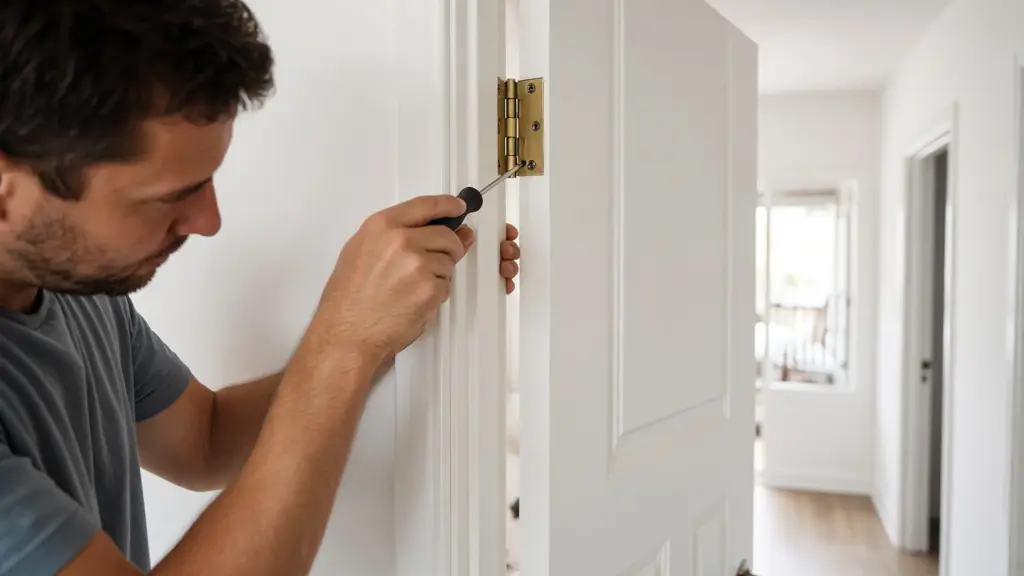
A door that rubs, sticks or has to be shoved closed is usually telling you something simple: a hinge has worked loose and the door has dropped a little. Fix that first, and many sticking doors close smoothly again without any cutting.
This guide covers standard hinged interior doors. If your door won't latch rather than stick, see how to fix a door that won't latch.
Tools and materials
- Screwdriver (often #2 Phillips) or a drill/driver with a clutch
- 3-inch wood screws matching the hinge screw head (for the frame side)
- Pencil, or a sheet of paper
- Thin cardboard shims (cut from a cereal box) for hinge shimming
- Sandpaper (80 and 120 grit) and a sanding block
- Optional: a hand plane, sawhorses and a helper if the door must come off
- Paint, primer or wood sealer for any bare edges
Step 1: Find where it rubs
Close the door slowly and watch the gap between the door and the frame.
- The gap is tight at the top latch-side corner and wide at the bottom: the door is sagging, usually from a loose top hinge.
- It rubs along the bottom: sagging, or a new rug or floor.
- It rubs on the hinge side: a hinge leaf may be set too deep (over-mortised), or there's paint buildup.
Can't see it? Slide a sheet of paper around the gap with the door closed, or rub pencil lead on the frame edge, close the door and look for the transfer mark on the door.
Step 2: Tighten every hinge screw
Open the door and tighten all screws on the frame side and the door side of each hinge. Turn them snug, but don't overdrive them, which can strip the wood.
Close the door and test again. Very often this alone fixes it.
Step 3: Use a longer screw in the top hinge
If a screw spins without tightening, or the top hinge still pulls away from the frame, replace one of the frame-side screws in the top hinge (the one closest to the stop molding is fine) with a 3-inch screw. It reaches through the jamb into the wall framing behind it and pulls the whole frame side up and in.
Drive it slowly and stop once it's snug. Overtightening can pull the jamb out of line. Check the door after each half turn.
For a stripped door-side screw hole, glue a few wooden toothpicks or a golf tee into the hole, let the glue dry, trim flush, and drive the screw back in.
Step 4: Shim a hinge if needed
Shimming changes the angle the door hangs at:
- Door rubs at the top latch corner: Shim behind the bottom hinge on the frame side; this tips the top of the door toward the hinge side.
- Door rubs at the bottom latch corner: Shim behind the top hinge.
To shim, loosen the hinge's frame-side screws, slip a piece of thin cardboard cut to the size of the hinge leaf behind it (with screw holes pierced or slotted), and retighten. Test, and add a second layer if needed.
Step 5: Sand or plane only as a last resort
If the door still rubs after the hinges are tight and adjusted, remove a small amount of wood:
- Mark the rubbing area with a pencil while the door is closed.
- For light rubbing on the latch edge, sand in place with 80-grit paper on a block, then 120.
- For the top or bottom edge, or more than a light sanding, take the door off. Tap out the hinge pins with a nail and hammer from below, with a helper holding the door, and lay it on sawhorses.
- Plane or sand toward the corners, not off them, to avoid splintering.
- Remove a little at a time and test-fit often.
Seal any bare wood, including top and bottom edges, with primer and paint or a clear sealer. Unsealed edges absorb moisture and can make the problem return.
Special cases
- Seasonal sticking: Doors that stick only in humid months often need only a light sanding and sealing of all six faces and edges. Running a dehumidifier in damp areas also helps.
- Paint buildup: Repeated coats on the door edge or stop molding can cause rubbing. Sand back to a smooth surface and repaint with a thin coat.
- Hollow-core doors: Plane very little from these. The solid wood frame around the edges is narrow, and cutting too far exposes the hollow interior.
- Fire-rated doors: Doors between an attached garage and the house are often fire-rated. Don't cut them down or remove self-closing hardware; ask a professional if one sticks.
When to call a pro
- Multiple doors start sticking at the same time, or new cracks appear in the walls above doors.
- The frame is visibly out of square or the jamb is split.
- The door is a heavy solid-wood or exterior door that needs significant trimming.
Related guides
Sources and further reading
- Your door or hinge manufacturer's installation sheet (hinge screw sizes and adjustment guidance)
- U.S. Fire Administration: Home fire safety (why fire-rated garage-to-house doors should stay unmodified)
Sources checked October 23, 2026. If something here does not match your product's manual, follow the manual and let us know.
Frequently asked questions
Why do doors stick more in summer?
Wood absorbs moisture when humidity is high and swells slightly. A door that only sticks in humid months may need nothing more than a light sanding and fresh paint or sealer on all edges.
Should I plane the door first?
No. Most sticking comes from loose or sagging hinges. Planing removes wood you can't put back, so tighten and adjust the hinges first.
Do I need to seal the edge after sanding?
Yes. Bare wood absorbs moisture faster. Paint or seal the sanded edge, including the top and bottom if you worked on them, so the door stays stable.
What if the frame itself is out of square?
Large or growing gaps, cracks above the door or doors throughout the house that suddenly stick can indicate settlement. Have a contractor or structural professional look at it.