How to Clean Refrigerator Condenser Coils (and Check if Yours Even Need It)
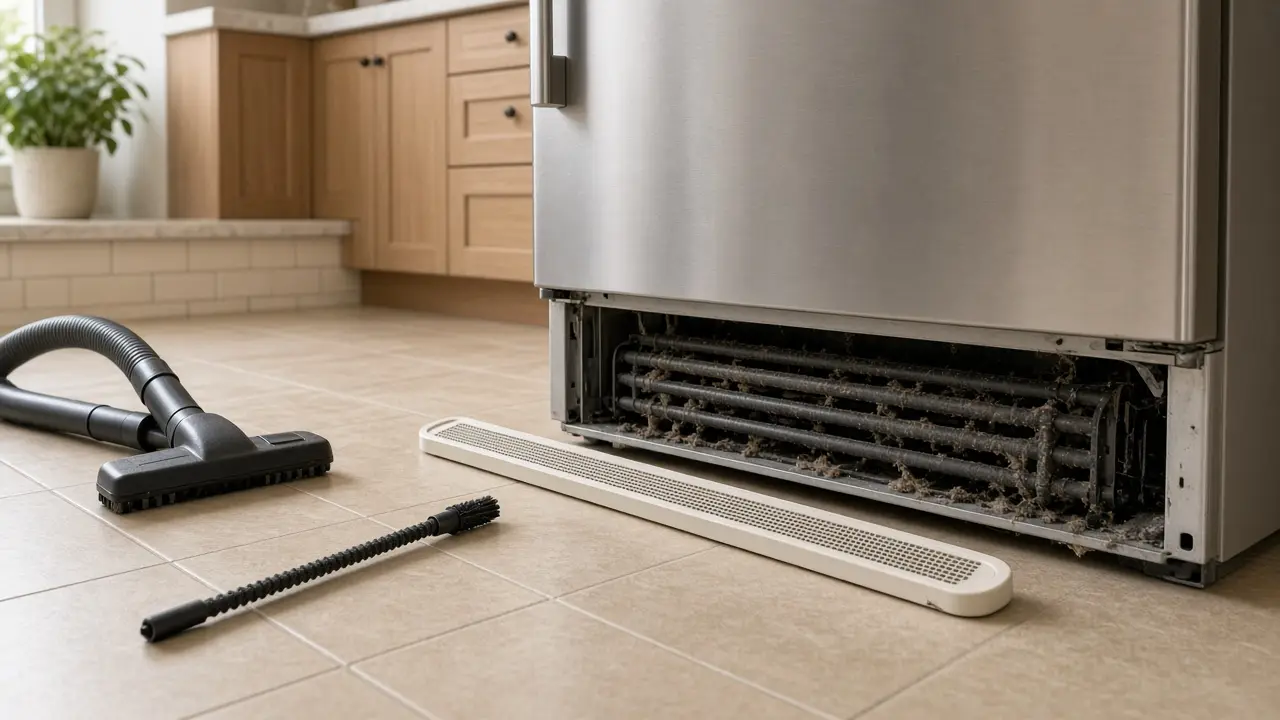
Your refrigerator keeps food cold by moving heat out of the cabinet and releasing it through a set of tubes called the condenser coils. When those coils are coated in dust and pet hair, the heat has a harder time escaping, and the fridge has to run longer to keep up. GE Appliances says dirty coils make a refrigerator work harder, which can shorten its lifespan and raise your energy bill.
The fix is usually a 20-minute job with a brush and a vacuum. But before you pull anything apart, check whether your model needs it at all: many newer refrigerators are designed so the coils never need cleaning.
This guide is based on care instructions from GE Appliances and Whirlpool, and the U.S. Department of Energy's Building America Solution Center. Your owner's manual always comes first, because coil location and cleaning rules differ by model.
Step 1: Find out whether your coils need cleaning
Look up your model's owner's manual (the model number is usually on a label inside the fresh-food compartment). You're looking for one of three situations:
- Coils that don't need cleaning. GE says most of its refrigerators made since 2001 have a "NeverClean" condenser, where the coils sit inside the compressor housing and stay clean under normal conditions. Whirlpool says some of its models don't require cleaning either.
- Coils that only a technician should clean. Whirlpool notes that on some models the condenser can only be cleaned by a certified technician. If your manual says to call for service, do that rather than taking panels off.
- Coils you can clean yourself. These are behind the bottom front grille, on the back of the fridge, or (on some built-in models) on top behind a grille.
If your manual doesn't say, you can still safely vacuum the base grille and the floor under the fridge, which is where dust collects first.
Step 2: Decide how often to do it
There's no single schedule that fits every home:
- Whirlpool: routine condenser cleaning isn't typically needed in a normal home, but homes with pets, heavy kitchen traffic or construction dust should inspect and clean every 3 to 6 months.
- GE Appliances Factory Service: vacuum accessible coils about once a season.
- Building America Solution Center (U.S. DOE): clean coils behind or below the fridge every 6 to 12 months.
A good rule of thumb: check the coils at least once a year, and more often if you have a dog or cat that sheds, the fridge is in a garage, or you've had recent remodeling dust.
What you'll need
- A refrigerator condenser coil brush (long and thin, sold at hardware stores and by appliance makers), or another soft-bristle brush
- A vacuum with a hose and a crevice or soft-brush attachment
- A flashlight
- Gloves and a long-sleeved shirt (condenser fins can have sharp edges)
- Safety glasses and a dust mask if you're sensitive to dust
- A screwdriver, if your base grille is held on with screws
Step 3: Turn off the power
Unplug the refrigerator, or switch off its circuit breaker if you can't reach the plug. GE and Whirlpool both list this as the first step, both to prevent electric shock and so the condenser fan can't start while your hands are near it.
Food will be fine for a short job if you keep the doors closed. The Building America Solution Center suggests finishing within two hours.
Step 4: Clean the coils for your layout
Coils at the bottom, behind the front grille
This is the most common layout on newer refrigerators.
- Open the doors if needed and remove the base grille (kick plate). Many grilles snap off: Whirlpool's instructions for one style are to place your hands at the ends of the grille, push in on the top and pull up on the bottom. Others are held by two screws.
- Shine a flashlight underneath to see the coils and the condenser fan.
- Slide the coil brush in and gently work it back and forth along the coils to loosen dust and pet hair. Don't force it, and avoid bending fins or tubes.
- Vacuum up the loosened dust from the coils, the open area behind the grille and the floor. Alternating brushing and vacuuming works better than either one alone.
- Vacuum or wash the grille itself. The Building America Solution Center suggests soaking it in warm water with a few drops of dish soap, scrubbing, rinsing and letting it dry before you put it back.
- Snap or screw the grille back into place.
Coils on the back
- Pull the refrigerator straight out from the wall. Go slowly, and watch the water line if your fridge has an ice maker or dispenser. Whirlpool specifically says not to disturb the water lines.
- Brush the coils from top to bottom with the coil brush, then vacuum up the dust.
- Vacuum the floor and the wall behind the fridge.
- Push the fridge back, being careful, as GE puts it, not to run over any cords or tubing. Leave the space behind the fridge that the manual specifies so air can move.
Coils on top (some built-in models)
GE's instructions for this layout are to switch off power at the breaker, raise the top front grille, and reach back to the condenser behind the compressor with a soft brush while vacuuming the loosened dust. Wear gloves and long sleeves, because the fins are sharp. If you can't reach comfortably, this is a reasonable job to hand to a technician.
Step 5: Wipe stubborn dust (optional)
If dust is caked on and you can reach the coils easily, the Building America Solution Center says you can wipe them with a rag dampened in warm water and a few drops of dish soap, then let them air-dry. Keep the rag damp, not dripping, and never spray liquid into the machine compartment.
Step 6: Restore power and check
Plug the refrigerator back in or switch the breaker back on. It may run continuously for a while as it pulls the temperature back down, which is normal. Give it a few hours, then check that both compartments feel as cold as usual.
Safety notes
- Always disconnect power first. The condenser fan can start without warning.
- Mind the sharp fins. Wear gloves and long sleeves.
- Protect the water line. Pulling a fridge out too far or too fast can kink or disconnect it.
- Don't use flammable cleaners anywhere near the coils or compressor.
- Get help moving a heavy fridge, and protect your floor from scratches.
When to call an appliance technician
Cleaning the coils is routine maintenance, not a repair. Call a qualified appliance technician if:
- Your manual says the condenser should only be cleaned by service.
- The fridge still isn't cold enough a few hours after the coils are clean.
- The condenser fan doesn't spin when the compressor runs, or you hear grinding or loud buzzing. GE notes that a failed condenser fan lets refrigerant temperatures rise and can make the outside walls very hot.
- You see oily residue on the tubing or smell refrigerant, which can point to a sealed-system leak.
- The fridge cycles on and off constantly, trips the breaker, or the compressor feels extremely hot.
Related guides
- How to Clean a Range Hood Filter (Mesh, Baffle and Charcoal)
- How to Clean a Dryer Vent Safely (and Why It Matters)
- How to Test and Replace Smoke Alarm Batteries (and When to Replace the Alarm)
Sources and further reading
- GE Appliances: Refrigerator, Cleaning Condenser Coils
- GE Appliances: Refrigerator, NeverClean Condenser
- GE Appliances Factory Service: Refrigerator maintenance tips
- Whirlpool: How and when to safely clean the condenser coils
- Building America Solution Center (U.S. DOE): Clean refrigerator condenser coils
Sources checked November 4, 2026. If something here does not match your refrigerator's instructions, follow the manufacturer and let us know.
Frequently asked questions
How often should I clean refrigerator condenser coils?
It depends on your model and home. Whirlpool says routine condenser cleaning is not typically needed in a normal home, but homes with pets, heavy kitchen traffic or construction dust should inspect and clean every 3 to 6 months. GE Appliances Factory Service suggests vacuuming accessible coils about once a season, and the U.S. Department of Energy's Building America Solution Center recommends every 6 to 12 months. Check your owner's manual first.
Where are the condenser coils on my refrigerator?
On most newer refrigerators they sit at the bottom, behind the front base grille (the kick plate). Older models often have them on the back, and some built-in models have them on top behind a grille. Many newer GE models have enclosed coils in the compressor housing that don't need cleaning at all.
Do I need to unplug the refrigerator to clean the coils?
Yes. GE and Whirlpool both say to unplug the refrigerator or switch off its circuit breaker before cleaning the coils, to reduce the risk of electric shock and keep you clear of the condenser fan.
Can dirty coils make my fridge stop cooling?
They can contribute. GE says that if a refrigerator runs but isn't cold enough, the condenser coils may need cleaning, because dust stops them releasing heat efficiently. If the fridge still isn't cold after the coils are clean, the cause may be a fan, a thermostat or a sealed-system problem that needs a technician.
Can I use water or a cleaner on the coils?
Start dry with a soft brush and vacuum. The Building America Solution Center says that, once vacuumed, coils you can reach can be wiped with a rag dampened in warm water with a few drops of dish soap and left to air-dry. Never spray water into the machine compartment, and don't use flammable cleaners.