How to Fix a Cabinet Door That Won't Close (Hinge Adjustments and Quick Fixes)
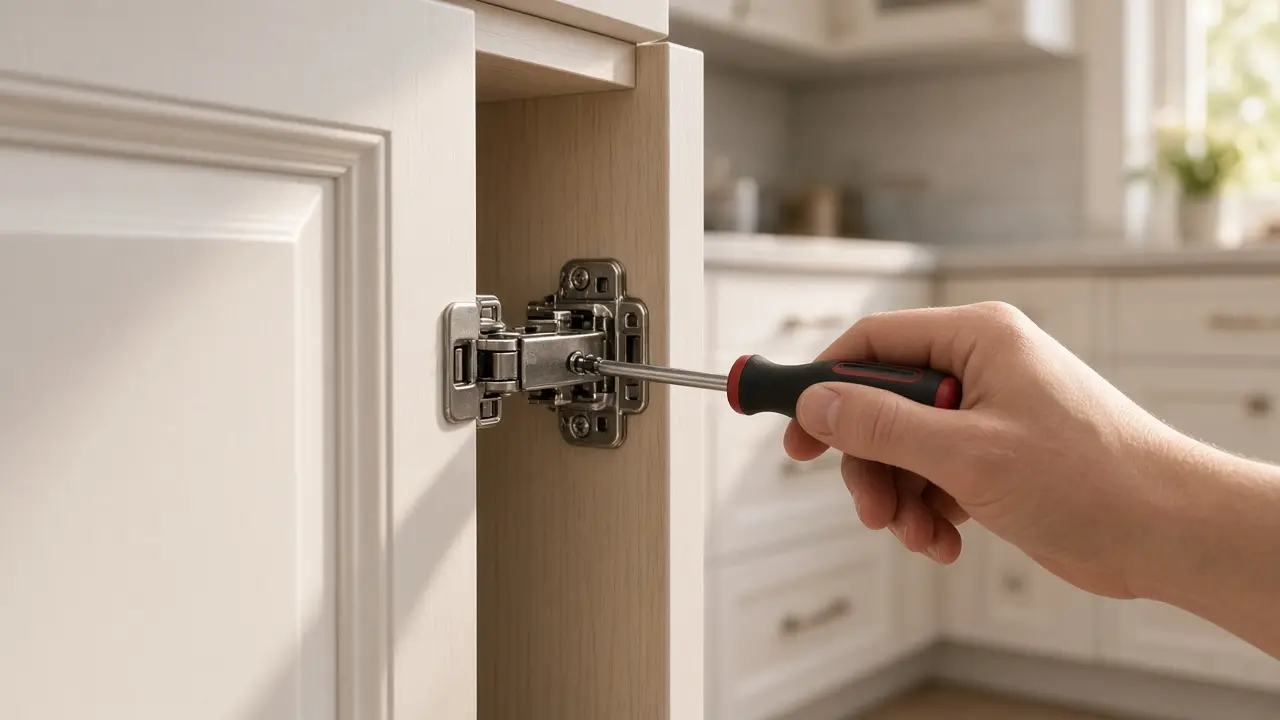
A cabinet door that won't close, hangs crooked or bounces back open is one of the easiest home annoyances to fix. On most modern cabinets the culprit is a concealed hinge that has drifted out of adjustment, and the fix takes a screwdriver and a few minutes. This guide shows you how to find the cause, how the adjustment screws on a typical European cup hinge work, and what to do about loose screws, stripped holes and catches.
What you'll need
- A #2 Phillips screwdriver (Blum recommends a #2 Pozi driver for its hinge adjustments; a #2 Phillips usually fits too)
- A flashlight
- Wood glue and wooden toothpicks or a wooden golf tee (for stripped screw holes)
- A utility knife or flush-cut saw (to trim the repair)
- Optional: a replacement hinge or catch of the same type
Safety first
- Empty heavy shelves before working on a door, especially upper cabinets, so nothing falls when you open and close it repeatedly.
- Support the door whenever you loosen mounting screws or unclip a hinge. A door that drops can pinch fingers, chip the countertop or tear out a screw.
- Take extra care with glass or mirrored doors, which are heavier and can break. If one is badly out of line or a hinge is damaged, consider getting help.
- Don't overtighten screws in particleboard or MDF. It strips the hole and creates a bigger problem.
Step 1: Find out what's stopping the door
Before you touch a screw, close the door slowly and watch where it stops.
- Look inside. A box, a pan handle, a shelf that has slipped forward or a shelf pin sticking out can stop a door. Clear it and try again.
- Check the edges. Does the door rub the cabinet frame, or hit the door next to it? Light marks or worn finish on an edge tell you where it's touching.
- Check the gaps. Stand back and compare the gap between this door and its neighbors. A door that is higher on one side, tilted, or sticks out at the top or bottom corner needs a hinge adjustment.
- Wiggle the door gently while it's open. If it moves at the hinge, a screw is loose or a hinge isn't clipped on properly.
- Check the catch. Older or face-frame cabinets often use a magnetic or roller catch. If the door closes but won't stay shut, or bounces off the catch, the catch is the problem (see Step 5).
Step 2: Identify your hinge type
Open the door and look at the hinge.
- Concealed (European) cup hinge: A round cup is set into a hole in the back of the door, with a hinge arm that attaches to a mounting plate on the inside of the cabinet. This is the most common type on modern and frameless cabinets, and it has built-in adjustment screws.
- Visible or surface hinges: Common on older face-frame cabinets. They usually have no adjustment screws, so fixes come down to tightening screws, repairing holes or shimming.
The rest of this guide focuses on concealed hinges first, because that's where most "won't close" problems live.
Step 3: Make sure the hinge is attached correctly
Many concealed hinges, including Blum's CLIP top, clip onto their mounting plate. If a hinge arm is only half clipped on, the door sags and won't close.
- Blum's instructions say to attach the door by placing the hinge on the mounting plate and pushing the back of the hinge arm down with finger pressure until it clicks. The click confirms it's secure.
- To remove a door, Blum's hinges have a release lever under the hinge arm. Support the door with one hand while you release it.
Re-clip any hinge that has come loose, then test the door again.
Step 4: Adjust a concealed hinge
Concealed hinges typically adjust in three directions. The screws below are based on Blum's CLIP top instructions; other brands use similar layouts, but check your hinge's own instructions if it looks different. Make small adjustments, about a quarter turn at a time, and adjust all the hinges on a door evenly unless you're deliberately correcting a tilt.
Side to side (the front screw)
The screw nearest the front of the hinge arm moves the door sideways, which changes how much the door overlaps the cabinet. Blum lists a range of plus or minus 2 mm.
- Use this when the door rubs the frame or the neighboring door on the side, or when the gap between two doors is uneven.
- If the door is tilted (the top corner touches its neighbor but the bottom has a gap, or the other way round), adjust only the top or only the bottom hinge to straighten it.
In and out (the rear or depth screw)
The rear screw moves the door closer to or farther from the cabinet box. On CLIP top hinges, Blum says to turn the rear spiral cam screw, with a range of +3 mm/–2 mm. On some older CLIP hinges you instead loosen the rear screw, slide the door to position and retighten.
- Use this when the door won't sit flush, sticks out at one corner, or catches on the cabinet edge just before closing.
Up and down (the mounting plate)
Height is set at the mounting plate on the cabinet side. Depending on the plate, Blum's instructions say to either turn a cam screw on the plate (about plus or minus 2 mm) or loosen the plate's screws, move the door to position and retighten them.
- Use this when the door is higher or lower than its neighbors or rubs the top or bottom of the opening.
- Support the door while the plate screws are loose so it doesn't drop.
After each adjustment, close the door and look at the gaps again. It often takes two or three rounds to get a door perfectly even.
Step 5: Fix loose or stripped screws
If a hinge or mounting plate wiggles, tighten its screws snugly by hand.
If a screw just spins and won't tighten, the hole is stripped. A common fix:
- Remove the screw, and support or remove the door.
- Put a little wood glue in the hole and push in a few wooden toothpicks or a wooden golf tee until the hole is packed.
- Let the glue dry fully (follow the glue's label for the time).
- Trim the wood flush with a utility knife or flush-cut saw.
- Drive the screw back in, stopping as soon as it's snug.
If the particleboard around the hole has crumbled, or the hinge cup is pulling out of the door, a simple plug won't hold. The hinge may need to be moved slightly to fresh material, or the door or panel repaired. That's a good point to call a carpenter or cabinet installer.
Step 6: Check soft-close hinges and catches
Soft-close hinges: These slow the door down near the end of its swing. Blum notes that on small or light doors, the soft-close (BLUMOTION) can be switched off on one of the hinges using the switch on the hinge cup, and the door has to be closed once for that to take effect. If a light door stops just short of closing, try this. If a soft-close door slams or closes unevenly, compare the hinges: a damper may have been switched off, or one hinge may need replacing.
Magnetic catches: If the door won't stay closed, the magnet and its strike plate may not line up. Loosen the catch screws, slide it forward or back so it meets the strike plate when the door is closed, and retighten.
Roller or friction catches: Tighten the mounting screws and adjust the catch position so the door clicks shut without having to be slammed.
When to call a pro (or replace parts)
- A hinge is cracked, bent or rusted through, its spring is broken, or it won't stay clipped on. Replace it with a compatible hinge and plate.
- The door itself is warped, split or delaminating. Adjustment won't fix a warped door.
- The cabinet box is sagging, pulling away from the wall or the face frame is loose. An upper cabinet that moves is a safety issue, so stop using it and have it checked.
- The screw holes in the cabinet or door have crumbled and won't hold a repair.
- Glass or very heavy doors that need significant adjustment.
Related guides
- How to Fix a Squeaky Door Hinge (Without Making a Mess)
- How to Fix a Sticking Interior Door
- Door Won't Latch? How to Fix Strike Plate Misalignment
Sources and further reading
- Blum: CLIP top hinge attachment and adjustment (PDF)
- Blum: CLIP top BLUMOTION adjustment (PDF)
- Blum: CLIP top assembly and adjustment
Sources checked November 5, 2026. If something here does not match your hinge's instructions, follow the manufacturer and let us know.
Frequently asked questions
Why won't my cabinet door close all the way?
The most common reasons are something inside the cabinet blocking the door, a hinge that has drifted out of adjustment so the door rubs the frame or the next door, hinge screws that have worked loose or stripped, or a catch that is out of line. Check for obstructions first, then look at the hinges.
Which screw on a cabinet hinge does what?
On a typical concealed (European) cup hinge such as Blum's CLIP top, the front screw on the hinge arm moves the door side to side, the rear screw moves it in and out (depth), and height is set at the mounting plate, either with a cam screw or by loosening the plate screws and sliding it. Other brands vary, so check the instructions for your hinge.
How do I fix a stripped cabinet hinge screw hole?
A common repair is to pack the hole with wood glue and a few wooden toothpicks or a wooden golf tee, let the glue dry, trim it flush and drive the screw back in. Don't overtighten, especially in particleboard. If the material around the hole has crumbled, the hinge may need to be moved or the panel repaired.
Why does my soft-close cabinet door not shut on its own?
Soft-close dampers slow the door near the end of its swing. Blum notes that on small or light doors the soft-close can be switched off on one of the hinges; if a light door stops just short of closing, that may help. Also check that the door isn't rubbing and the hinges are properly clipped on.
When should I replace the hinge instead of adjusting it?
Replace a hinge if it is cracked or bent, the spring is broken, the hinge arm won't stay clipped to its plate, or adjusting doesn't change anything. Take the old hinge to the store or note the brand and model so you get a compatible replacement and mounting plate.