How to Clean a Dishwasher Filter (Step by Step, by Filter Type)
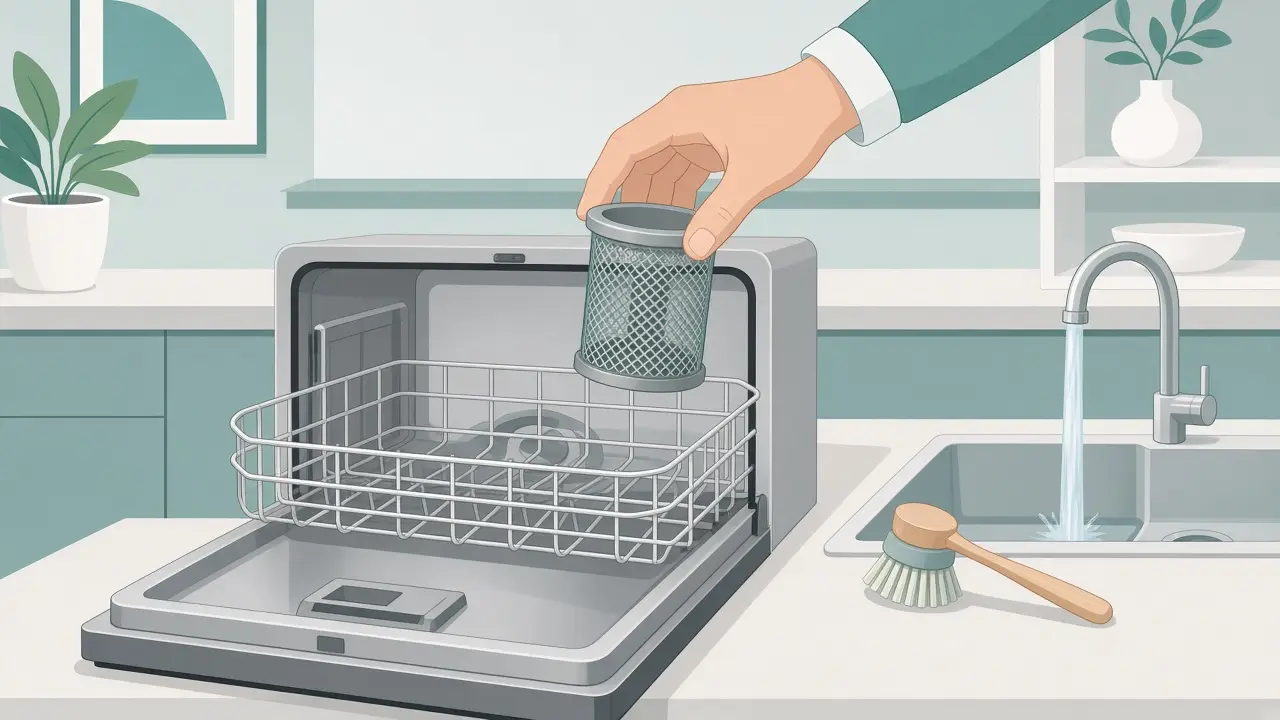
If your dishwasher has started leaving grit on glasses, food specks on plates, or a puddle in the bottom of the tub, the first thing to check is the filter. Most modern dishwashers have a removable filter in the floor of the tub that catches food so it doesn't get sprayed back onto your dishes or clog the pump. Bosch lists three jobs for it: protecting the pump from food debris, cleaning the dishwater, and keeping food particles from landing back on your dishes.
Cleaning it takes about 10 minutes and no tools. This guide follows the care instructions published by GE Appliances, Whirlpool, KitchenAid and Bosch. Designs differ a little between brands, so keep your owner's manual handy if yours looks different.
Signs your filter needs cleaning
Whirlpool's and KitchenAid's manuals say the filters may need cleaning when:
- You can see food or other objects on the filter
- Cleaning performance drops, and dishes come out with soil still on them
- Dishes feel gritty to the touch
KitchenAid also lists smells or odors coming from the dishwasher, and Bosch notes that a blocked filter can keep the dishwasher from pumping out water properly.
How often to clean it
There's no single rule, because it depends on your machine and your habits:
| Source | What it recommends |
|---|---|
| GE Appliances | Inspect and clean the Fine and Ultra Fine filters every other month, or more depending on usage |
| Whirlpool and KitchenAid | Once a month as a general rule; every two weeks for a large family or daily use |
| Whirlpool owner's manual | At least once a month if you have very hard water (above 15 grains) |
| Bosch (US) | Every few months for best results |
Whirlpool's and KitchenAid's manuals include charts that stretch the interval if you scrape or rinse dishes before loading, and shorten it if you run many loads a week without scraping. If you're not sure, checking once a month costs nothing and you'll quickly learn how fast yours gets dirty.
Before you start
- Find your manual. Search your brand's site for your model number (usually printed on a label on the edge of the door or the tub opening).
- Gather supplies: a soft brush (an old toothbrush or a dish brush), a sponge, dish soap, and a towel.
- Wear gloves if you've broken a glass recently. Filters can trap glass shards. Bosch's pump-cleaning instructions tell you to wear protective gloves before putting your fingers in the pump area for this reason.
- Let it cool. If the dishwasher just finished a hot cycle, wait for the tub and water to cool.
You don't normally need to cut power just to lift out the filter, since you aren't touching any wiring. But if your manual says to disconnect power before maintenance, follow it, and always do so before reaching into the pump area.
Step 1: Take out the bottom rack
Pull the lower rack all the way out and set it aside. The filter sits in the floor of the tub, usually at the back or in the middle under the lower spray arm. Bosch's US instructions say to remove the lower spray arm as well on its models.
Step 2: Remove the filter
Most filters are a round cup or cylinder that twists out:
- Whirlpool and KitchenAid: Turn the upper filter assembly a quarter turn counterclockwise and lift it out. Then grasp the lower filter (a flat plate) in its circular opening, lift slightly, and pull it forward.
- GE Appliances: Twist the Ultra Fine Filter counterclockwise and lift it out. To remove the Fine Filter (the mesh plate), GE says to twist the two retaining posts at the back bottom of the tub counterclockwise and lift it out. Some GE models have a two-piece Ultra Fine assembly with a separate filter basket that twists off counterclockwise.
- Bosch: Turn the coarse filter counterclockwise and lift the filter system out. In the Bosch manual for one current model, you then pull down the micro filter, and press the locking catches together to separate the coarse filter. Bosch warns to check that nothing falls into the sump while the filter is out.
If you're unsure which way it turns, look for arrows or "lock" and "unlock" marks molded into the plastic.
Step 3: Empty and rinse it
Shake the food and debris into the trash, not down the sink. Then rinse each piece under running water. Whirlpool says to rinse until most soils are removed. GE recommends warm soapy water and a sponge.
Step 4: Clean off stubborn gunk gently
For stuck-on food, grease or white hard-water deposits, use a soft brush. All four brands agree on what not to use:
- No wire brushes
- No scouring pads or steel wool
- Nothing abrasive
Whirlpool and KitchenAid say these may damage the filters, and GE says scouring pads or brushes can scratch the filter surface. Bosch UK suggests that if you prefer, you can soak the filter in soapy water first; just rinse the soap off before you put it back.
Bosch's manual also says to carefully clean the rim of dirt between the coarse and fine filters, which is easy to miss.
Step 5: Wipe out the filter opening
While the filter is out, look into the opening in the tub floor. Wipe out loose food or sludge around the rim with a damp cloth or sponge. Don't push anything down into the hole, and don't poke at the pump or its cover unless your manual describes how.
Step 6: Put it back and make sure it locks
This step matters. A filter that isn't locked in can let debris reach the pump.
- Whirlpool and KitchenAid: Slide the lower filter plate under the locating tabs so its round opening lines up with the opening in the tub. Insert the upper assembly, then slowly turn it clockwise until it drops and locks. KitchenAid notes the arrows don't have to line up as long as the filter is locked. If it still spins freely, it is not locked; keep turning clockwise.
- GE Appliances: Replace the Fine Filter and turn its retaining posts clockwise, then set the Ultra Fine Filter in and twist it clockwise to lock. GE says an arrow embossed in the Fine Filter shows how to align it.
- Bosch: Reassemble the filter pieces, make sure the locking catches click into position, insert the filter system and turn it clockwise until the arrow markings match up.
Whirlpool and KitchenAid both warn: don't run the dishwasher without the filters properly installed, because it can damage the machine.
Put the bottom rack back. Some Whirlpool models have a "Clean Filter" indicator; Whirlpool says to clean and replace the filter, hold the Clean Filter button for 3 seconds, then open and close the door to reset it.
Step 7: Clean the spray arms while you're there
If dishes were coming out dirty, the spray arm holes may also be clogged. GE Appliances suggests using a small object such as a paper clip or tweezers to loosen debris from blocked jets, taking care not to damage them. Spin each arm by hand afterward; Whirlpool's quick steps say the spray arms should turn freely.
Keep it cleaner for longer
- Scrape plates before loading. GE recommends scraping excess food off dishes to keep it out of the dishwasher. Whirlpool's manual says you don't need to pre-rinse, and that just scraping saves water, energy and time; the trade-off is cleaning the filter a little more often.
- Leave the door slightly ajar if you won't use it for a while. Bosch's manual says this helps prevent unpleasant odors.
- Don't use chlorine-based cleaners in the tub. Bosch's manual warns that detergents containing chlorine may harm your health and says never to use them.
- Hard water? White film on dishes is a sign of hard water, according to Whirlpool. Clean the filter more often and use a dishwasher cleaner product as your manual suggests.
When to call a pro
Cleaning the filter fixes many problems, but book a repair visit if:
- There's still a lot of standing water after you've cleaned the filter. Bosch UK says up to about two cups can be normal; much more than that points to the drain pump, drain hose or drain connection.
- You hear grinding or humming from the pump, or suspect broken glass is stuck in it and you aren't comfortable removing the pump cover as your manual describes
- The filter won't lock back in, or tabs and posts are cracked (order the correct replacement part for your model)
- The dishwasher is leaking onto the floor
- You smell burning or see scorch marks. Turn off the dishwasher's power at the breaker and don't use it until it's checked.
Related guides
- How to Clean a Range Hood Filter (Mesh, Baffle and Charcoal)
- Garbage Disposal Humming But Not Working? How to Unjam It
- How to Unclog a Kitchen Sink: Plunger, P-Trap and Snake Methods
Sources and further reading
- GE Appliances: Dishwasher - How to Clean Fine and Ultra Fine Filters
- GE Appliances: Dishwasher - Not Washing Properly
- Whirlpool Product Help: How to Clean the Dishwasher Filters
- Whirlpool Product Help: Cleaning the Filter - Dishwasher
- KitchenAid Product Help: How to Clean the Dishwasher Filters
- Bosch: How to Properly Clean Your Dishwasher Filter
- Bosch UK: Should there be water at the bottom of my dishwasher?
- Bosch: SMS2ITW00X Dishwasher Manual (PDF)
Sources checked 2026-11-11. Whirlpool and KitchenAid owner's manuals (documents W10667785 and W10579121) were also consulted. Filter designs vary by brand and model, so follow your owner's manual where it differs. If something here doesn't match your dishwasher, let us know.
Frequently asked questions
How often should I clean my dishwasher filter?
It depends on the brand, how many loads you run and how well you scrape dishes. GE Appliances says to inspect and clean its Fine and Ultra Fine filters every other month or more depending on usage. Whirlpool and KitchenAid give a general rule of once a month, or every two weeks for a large family or daily use, and their manuals list longer intervals if you scrape or rinse dishes first. With very hard water (above 15 grains), Whirlpool's manual says to clean the filter at least once a month.
Does my dishwasher even have a removable filter?
Most newer models do. GE Appliances notes that older GE dishwashers and some current models use self-cleaning filtration, usually with no removable filter to clean. Pull out the bottom rack and look at the floor of the tub: a round cup or cylinder you can twist, often with a flat mesh plate around it, is a removable filter. If you see nothing removable, check your owner's manual.
Can I put the dishwasher filter in the dishwasher or scrub it with steel wool?
Wash it by hand. Whirlpool, KitchenAid and GE all say to rinse the filter under running or warm soapy water and to avoid wire brushes, scouring pads and abrasive tools, which can damage or scratch the mesh. A soft brush or sponge is fine for stuck food or hard-water deposits.
Can I run the dishwasher without the filter?
No. Whirlpool and KitchenAid warn not to operate the dishwasher without the filters properly installed, because it can damage the dishwasher. The filter also protects the pump from food debris, as Bosch explains.
My dishwasher still has standing water after I cleaned the filter. What next?
A small amount of water can be normal. Bosch UK says up to about two cups left in the tub after a cycle is normal. If there is much more, the drain pump, the drain hose or the sink drain and garbage disposal connection may be the cause. If you are not comfortable checking those, or the problem continues, book a service visit.